



De-Risking Dissent: Climate justice defenders and the expanding reach of counter-terrorism financing regulation
New research by human rights researcher Floor Knoote and criminologist Annika van Baar shows that anti-money laundering and anti-terrorism regulations have serious consequences for climate and human rights defenders worldwide. Climate activists are coming under pressure globally due to transfer blockades, delayed payments, and excessive scrutiny – sometimes deliberately deployed by governments. The research calls for a review of banking and oversight practices, so that governments and the financial sector can achieve their green ambitions.
Climate justice organizations increasingly face fierce repression through laws criminalizing expression and assembly, exclusion from policy-making, and punitive lawsuits. They are also subjected to physical persecution, arbitrary arrests, forced disappearances, and even murder, alongside growing stigmatization as “eco-terrorists.” This escalating State repression of climate justice and just transition defenders has raised serious concerns among researchers and organizations.
To date, little is known about the specific impact of measures aimed to counter money laundering and terrorist financing (‘AML-CFT measures’) on organizations focused on climate justice - this study aimed to bridge that gap. To capture the AML-CFT related impacts, we conducted a survey among climate justice and environmental organizations, to which 39 organizations responded, based in 24 countries. We received responses from organizations from Africa, Asia, Europe and Latin America.
Empirical Findings
Survey findings show that climate justice organizations face escalating financial restrictions, with 87% reporting stricter fund transfer conditions and 53% experiencing frequent banking obstacles such as delays, blocked payments, and excessive documentation demands, in some cases forcing them to halt international transactions altogether. Our data contains strong indications that banks have increased their due diligence demands of organizations working on climate justice, leading to a range of banking issues that directly impact their work, due to bank transfer delays and refusals, as well as account freezes.
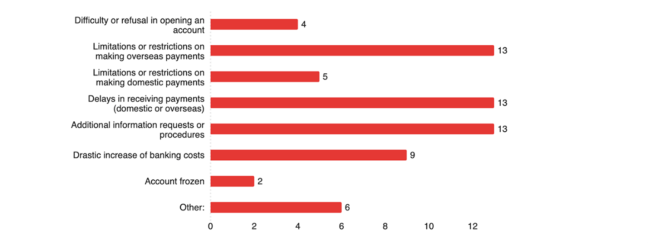
Figure: Issues related to banking (source: Derisking Dissent, 2025).
The research also shows some indications that AML-CFT rules are being misused by governments, which via banks, try to restrict the effectiveness of organizations to limit organizations working on climate justice and a just transition. Several organizations report that tightened regulation creates a ‘climate of fear’ and that counterterrorism laws are actively ‘used as a tool for the government to intimidate communities and civil society.’ One respondent illustrates for example:
“You are always aware that there is a heavy cloud over you and that a certain law can be used against you.”¹
This tightening of bank due diligence—often driven by the misuse of AML-CFT regulations by governments—disrupts operations and compels organizations to delay activities, rely cautiously on informal financial channels, or even enter operational paralysis due to fear of sanctions. These compliance burdens drain significant financial and human resources, delay projects, restrict programmatic scope, and place severe personal strain on staff, ultimately undermining civil society’s capacity to advocate for climate justice and just transition.
“We can't implement any of these alternative payment strategies as then we will be even more suspect. With this we will open the gates of hell.”²
A worrying trend
The findings reveal a deeply concerning trend: AML-CFT frameworks, while intended to ensure global security via financial regulation, are increasingly becoming instruments of restriction for organizations working on climate justice. States are misusing AML-CFT frameworks to suppress politically inconvenient climate organizations, creating a widespread climate of fear and enabling targeted repression through banks and donors. This leads to de-risking, rising administrative costs, delayed projects, reduced funding, mental health strain on staff, and even reliance on informal payments. These impacts are especially damaging for smaller, grassroots climate justice groups that depend on transnational funding and lack the capacity to meet complex compliance demands.
Climate justice advocates face specific challenges because their efforts directly challenge the status quo that benefits powerful industries and those in positions of power at the state level. There is growing evidence that States and corporations are increasingly framing climate justice and environmental activists as national security threats rather than recognizing them as defenders of human and environmental rights, with some activists labeled as “terrorists” or extremists UN Rapporteur Michael Forst confirms that these laws are increasingly used to place communities standing up for their rights under heavy surveillance.
Conclusion
The UN has warned that climate change is the greatest existential threat to humanity—already destabilizing societies, ecosystems, and global security—yet in a stark contradiction, the very organizations working on the frontlines to confront this crisis are increasingly constrained by AML-CFT regulations. Originally designed to counter terrorism, these frameworks are now disproportionately restricting climate justice actors, obstructing the global response to an escalating emergency. This collision of security logics exposes how entrenched political and economic interests are reshaping regulatory systems at the expense of civil society, undermining the agency of those striving to protect vulnerable communities and build a just, livable future in the face of an existential crisis.
The study calls on governments and banks to prioritize a proportional, risk-based approach and actively prevent, monitor (e.g. collect data), investigate and report on all impacts of existing AML-CFT measures on the climate justice movement.
---------------------------------------------------------
1 Respondent from East Africa
2 Respondent from Eastern Europe
Author Bios

Floor Knoote
Floor Knoote is a human rights researcher that investigates corporate accountability for human rights and international crimes. She has led (field) studies for human rights documentation and to provide evidence for NGOs and strategic litigation. As part of her work, she researches attacks on civil society, including how countering the financing of terrorism (CFT) regulations are used—and misused—to silence human rights defenders.

Dr. Annika van Baar
Dr. Annika van Baar is assistant professor in Criminology at the Faculty of Law of VU University Amsterdam. In 2019, she obtained her PhD with a thesis on corporate involvement in international crimes, also at VU university. Her current research is directed at patterns and trends in corporate involvement in atrocity crimes and its (lack of) regulation and the field of business and human rights (e.g., (mandatory) human rights due diligence).